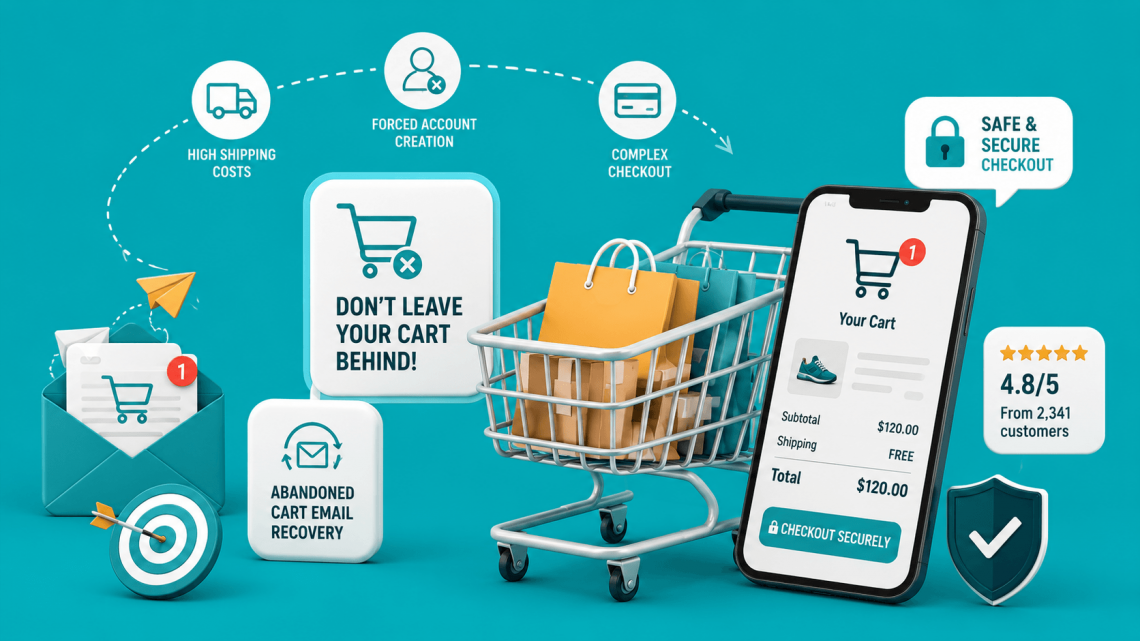
Seven out of ten shoppers walk away before completing a purchase. Here is exactly what to do about it, backed by data from thousands of ecommerce stores.
Average cart abandonment rate across all industries
Lost each year globally to abandoned carts
Of abandoned carts recoverable with a 3-email sequence
Mobile cart abandonment rate, the highest of any device
Quick Answer
To reduce cart abandonment, focus on five core areas: simplify checkout to fewer steps, display all costs upfront, offer guest checkout, send a 3-part abandoned cart email within 24 hours, and optimize your mobile experience. Brands that implement all five see average abandonment rate drops of 15 to 25 percentage points.
You worked hard to drive traffic to your store. You ran the ads, wrote the product descriptions, built the brand. And still, more than two thirds of shoppers who add something to their cart never check out.
Cart abandonment is not a minor inconvenience. It is the biggest leak in your ecommerce funnel, and plugging it even partially has a compounding effect on revenue that rivals any paid acquisition campaign.
This guide covers exactly what causes cart abandonment, how to measure it properly, and 18 specific strategies you can implement starting today. We have organized them from highest to lowest average impact so you can prioritize intelligently.
Why Customers Abandon Their Carts
Before fixing anything, you need to understand the actual reasons shoppers leave. The Baymard Institute, which runs the largest ongoing research study on checkout usability, identifies the top reasons year after year:
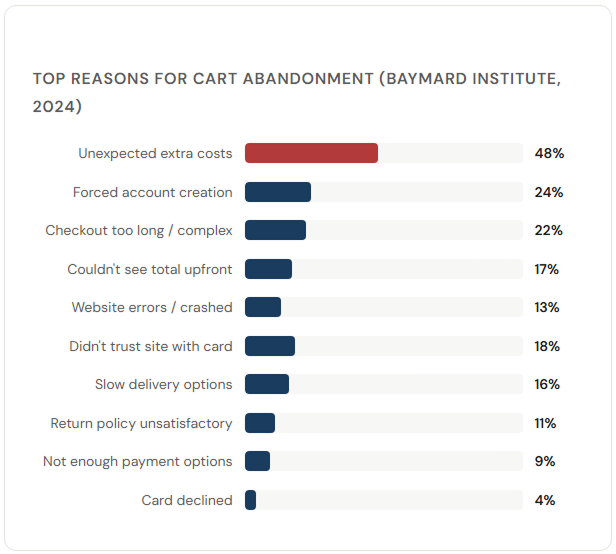
The important insight:
most cart abandonment is caused by friction, distrust, and unpleasant surprises, not by customers who never intended to buy. That means most of it is fixable.
How to Calculate Your Cart Abandonment Rate
Before you optimize, establish a baseline. Your cart abandonment rate is calculated as:
Track this metric weekly in Google Analytics 4, your ecommerce platform dashboard, or a dedicated conversion rate optimization tool. Segment it by device, traffic source, and product category to find where abandonment is highest in your specific store.
18 Strategies to Reduce Cart Abandonment
These strategies are grouped into four categories: checkout optimization, trust and transparency, recovery tactics, and advanced personalization. Apply them roughly in the order presented for the fastest return.
Part 1: Checkout Optimization
1 Remove forced account creation – Highest Impact
One in four shoppers abandon a cart specifically because they are required to create an account. The fix is simple: add a prominent guest checkout option and put it above the login form. You can invite account creation after the purchase is complete, when you have already earned the customer’s trust. ASOS implemented this change and saw a 50% reduction in checkout drop-off from this single friction point alone.
2 Reduce checkout to the fewest possible steps – Highest Impact
Every additional page in your checkout flow costs you roughly 10% more abandonment. The Baymard Institute found that the average ecommerce store has 23.48 form fields in checkout, when the ideal number is 12 to 14. Audit your checkout form and ruthlessly remove or combine any field that is not strictly necessary for completing the transaction. Combine first and last name into one field. Make company name optional. Use smart address autocomplete. Aim for a single-page or two-page checkout maximum.
3 Show all costs before the final step – Highest Impact
Unexpected shipping costs are the number one reason for cart abandonment at 48%. Display shipping costs, taxes, and any other fees on the product page or at the start of checkout, not on the final confirmation screen. A shipping estimator widget on the cart page goes a long way. If your margins allow it, build shipping costs into your product price and advertise free shipping: conversion rates consistently improve by 10 to 20% when free shipping is offered.
4 Add multiple payment methods – High Impact
Modern shoppers expect optionality at checkout. Offer at minimum: major credit and debit cards, PayPal, Apple Pay, Google Pay, and a buy-now-pay-later option like Afterpay, Klarna, or Affirm. BNPL alone can lift conversion by 20 to 30% in categories like fashion, home goods, and electronics. Each additional payment method you add removes a reason not to buy for a specific segment of your audience.
5 Optimize for mobile checkout – Highest Impact
Mobile accounts for more than 60% of ecommerce traffic, but mobile cart abandonment rates are nearly 85%. Most mobile checkout problems are fixable: use large, tap-friendly buttons (minimum 44px by 44px), trigger the numeric keyboard for phone and credit card fields, enable autofill, compress images so pages load in under 2 seconds on mobile, and test your entire checkout flow on at least three different real devices regularly. A 1-second improvement in mobile load time can lift conversion by up to 27%.
6 Show a clear progress indicator – Medium Impact
A simple step indicator (Step 1 of 3: Shipping) reduces anxiety and gives shoppers a sense of how close they are to the finish line. When shoppers know the end is near, they are far less likely to give up mid-process. Ensure each step is meaningfully named, not just numbered, and display what is completed versus what remains.
7 Enable cart persistence across sessions – Medium Impact
Not all cart abandonment is intentional. Shoppers get distracted, get a phone call, close a browser tab. If your cart empties between sessions, you have lost that purchase permanently. Save cart contents for at least 30 days for logged-in users and use cookies to persist carts for guest shoppers for at least 7 days. When a returning visitor lands on your site with items in their cart, show a “You left something behind” prompt immediately.
Part 2: Trust and Transparency
8 Display security badges and trust signals – High Impact
18% of cart abandonment is caused by shoppers not trusting the site with their payment information. Place SSL certificate badges, accepted card logos, and security seals (Norton, McAfee, Trustpilot) near your payment form. Do not hide them in a footer: they should be visible at the exact moment a shopper is entering card details. In A/B tests, adding prominent trust badges near checkout buttons increases conversion by 5 to 15%.
9 Make your return policy impossible to miss – Medium Impact
Uncertainty about what happens if something goes wrong is a major silent killer of conversions. Show a brief, reassuring return policy directly on your product page, on the cart page, and at checkout. “Free 30-day returns, no questions asked” displayed near the add-to-cart button consistently outperforms sites that bury this information in a footer. Generous, visible return policies reduce purchase anxiety and increase average order value simultaneously.
10 Add social proof at the point of purchase – High Impact
Display real customer reviews, star ratings, and user-generated photos directly on the cart page or checkout. A mini-review block showing “4.8 out of 5 from 2,341 verified buyers” near the checkout button is powerful positive reinforcement at exactly the right moment. Notifications like “37 people bought this in the last 24 hours” leverage social proof and urgency simultaneously.
11 Use exit-intent popups strategically – Medium Impact
When a shopper’s cursor moves toward the browser close button or tab bar, an exit-intent popup gives you one last chance to convert them before they leave. An effective popup is brief, valuable, and not annoying: offer a small discount (10% off your first order), free shipping, or a reminder of what is in their cart. Tools like Privy, OptiMonk, and Klaviyo all offer exit-intent triggers. Use them only on the cart and checkout pages, not on every page of your site, or you will train visitors to expect a discount and condition them to always abandon first.
Part 3: Recovery Tactics
No matter how well you optimize your checkout, some shoppers will still leave. Recovery tactics are how you win them back after they have gone.
12 Send a three-part abandoned cart email sequence
Abandoned cart emails are the highest-ROI email type in ecommerce, with an average open rate of 41% and a conversion rate of around 5 to 10%. The key is sending a sequence, not a single email. Here is the structure that consistently outperforms:

1 hour after abandonment
The Gentle Reminder
Simple, friendly reminder. Show their cart. No discount. Ask if they have questions.
Avg. open rate

24 hours after abandonment
Social Proof Push
Add urgency with stock levels. Show reviews. Still no discount — hold the offer.

72 hours after abandonment
The Final Offer
Now offer the incentive: 10% off, free shipping, or a bonus. Make it time-limited.
Pro tip: Suppress emails 2 and 3 for anyone who completes a purchase after email 1. Always include a one-click unsubscribe link. Personalize the subject line with the product name or the shopper’s first name: “Sarah, your [Product Name] is still waiting” consistently outperforms generic subject lines by 25 to 30%.
13 Run retargeting ads on Meta and Google – Highest Impact
For shoppers who did not give you their email, retargeting ads are your primary recovery channel. Use dynamic product ads on Meta (Facebook and Instagram) to show the exact item a shopper viewed or added to their cart. On Google, set up dynamic remarketing through Performance Max campaigns. Retargeting users who have abandoned a cart convert at 3 to 5 times the rate of cold traffic. Start your retargeting window at 7 days and extend to 30 days for high-consideration purchases. Cap frequency at 10 to 15 impressions per user per week to avoid ad fatigue.
14 Add SMS and push notification recovery – High Impact
SMS abandoned cart messages have open rates above 90% and click rates of 20 to 35%, making them significantly more visible than email. If a customer has opted in to SMS during a previous purchase, a single text message 30 to 60 minutes after abandonment (“Hey [Name], you left something in your cart. Here is your link back: [link]”) can recover sales that email misses. Push notifications on mobile apps function similarly and require no personal information beyond a device opt-in.
15 Use live chat and chatbots to address objections in real time – Medium Impact
A proactive chat bubble that triggers on the cart or checkout page with a message like “Have a question about this order? We reply in under 2 minutes” gives hesitant shoppers an immediate way to resolve concerns rather than leave. AI-powered chatbots can handle common questions about shipping, sizing, returns, and payment options around the clock. Stores with live chat on checkout pages report 10 to 15% lower abandonment rates than those without.
Part 4: Advanced and Personalization Strategies
16 Create urgency with real, honest scarcity signals – Medium Impact
Urgency is one of the most powerful motivators in ecommerce, but only when it is genuine. “Only 3 left in stock” converts. “Sale ends in 24 hours” on a perpetual timer does not, and it erodes trust when shoppers notice. Use real-time inventory data to display actual stock levels on high-demand products. Show limited-time free shipping windows (“Order in the next 2 hours for delivery by Thursday”). If you are running a genuine sale, add a countdown timer to the cart page. Fake scarcity is a short-term conversion gain and a long-term brand killer.
17 Personalize the cart experience using browsing data – Medium Impact
Use your ecommerce platform or a personalization tool to dynamically customize the cart page based on what you know about the shopper. Show recently viewed items below the cart to remind them of alternative options they considered. Display “Customers who bought this also loved” recommendations to increase average order value and give shoppers a reason to stay and explore. Personalized product recommendations on the cart page increase revenue per session by an average of 26% according to McKinsey research.
18 A/B test your checkout continuously – Medium Impact
Every store and audience is different. What works brilliantly for a luxury skincare brand may not work for a B2B software company. Continuous A/B testing is what separates stores that hit a plateau from those that keep improving. Test one element at a time: button copy (“Complete My Order” vs “Buy Now” vs “Pay Securely”), page layout (one page vs two page checkout), trust badge placement, free shipping threshold messaging, and email subject lines. Run each test for a minimum of two weeks or until statistical significance at 95% confidence. Build a testing calendar and never stop experimenting.
Your 90-Day Implementation Plan
You cannot do everything at once. Here is a prioritized sequence based on effort required versus impact delivered:
| Timeline | Action | Effort | Expected Impact |
|---|---|---|---|
| Week 1 to 2 | Enable guest checkout and simplify checkout form | Low | 10 to 15% abandonment reduction |
| Week 1 to 2 | Display shipping costs and taxes upfront | Low | 8 to 12% abandonment reduction |
| Week 2 to 4 | Set up 3-part abandoned cart email sequence | Medium | 5 to 10% recovery rate on abandoned carts |
| Week 2 to 4 | Add trust badges and visible return policy | Low | 5 to 8% conversion lift |
| Month 2 | Launch dynamic retargeting on Meta and Google | Medium | 3 to 5x ROI on retargeting spend |
| Month 2 | Optimize mobile checkout experience | Medium to High | 10 to 25% mobile conversion improvement |
| Month 3 | Add live chat to cart and checkout pages | Medium | 10 to 15% abandonment reduction |
| Month 3 | Begin A/B testing checkout elements | Ongoing | Compounding 1 to 3% gains per test |
Frequently Asked Questions About Cart Abandonment
The average cart abandonment rate across all industries is 70.19%, according to Baymard Institute’s ongoing aggregate research across 44 published studies. Fashion and apparel tend to run higher at around 75 to 80%, while B2B and software categories can be lower at 60 to 65%. Mobile abandonment consistently outpaces desktop at approximately 85%.
A cart abandonment rate below 60% is considered excellent and is achievable with well-optimized checkout flows. Most stores should aim to move from the industry average of 70% toward the 55 to 60% range as a realistic 12-month goal. Anything below 50% is exceptional and typically reflects stores with highly optimized mobile experiences, transparent pricing, and robust recovery programs.
Send the first abandoned cart email within 1 hour of abandonment. Research consistently shows that first emails sent within 60 minutes have open rates up to 40% higher than those sent after several hours. The second email should follow at 24 hours, and the third at 72 hours if the shopper has not yet returned to complete their purchase.
No, and this is an important nuance. Sending a discount immediately in your first email trains shoppers to abandon carts intentionally to receive a discount. Reserve the discount or incentive for the third email in your sequence, after the shopper has received two non-discount reminder emails. This approach recovers nearly as many carts while protecting your margins.
The most effective tools include: Klaviyo or Omnisend for abandoned cart email automation, Privy or OptiMonk for exit-intent popups, Gorgias or Tidio for cart-page live chat, Google Analytics 4 and Hotjar for checkout funnel analysis, and your ecommerce platform’s native features (Shopify Checkout, WooCommerce, BigCommerce) which increasingly include built-in cart recovery functionality.